 Loading Please Wait...
Loading Please Wait...
Loading Please Wait...
Social media has become one of the most powerful parts of modern life. It is used for communication, expression, business development, news monitoring, content creation and connecting with communities around the world. Facebook, Instagram, TikTok, YouTube and X have changed the way people connect on the internet. However, as social media has grown, so have concerns about privacy, censorship, data control, algorithms, and the power of big technology companies.
This is where decentralized social media platforms are beginning to rise.
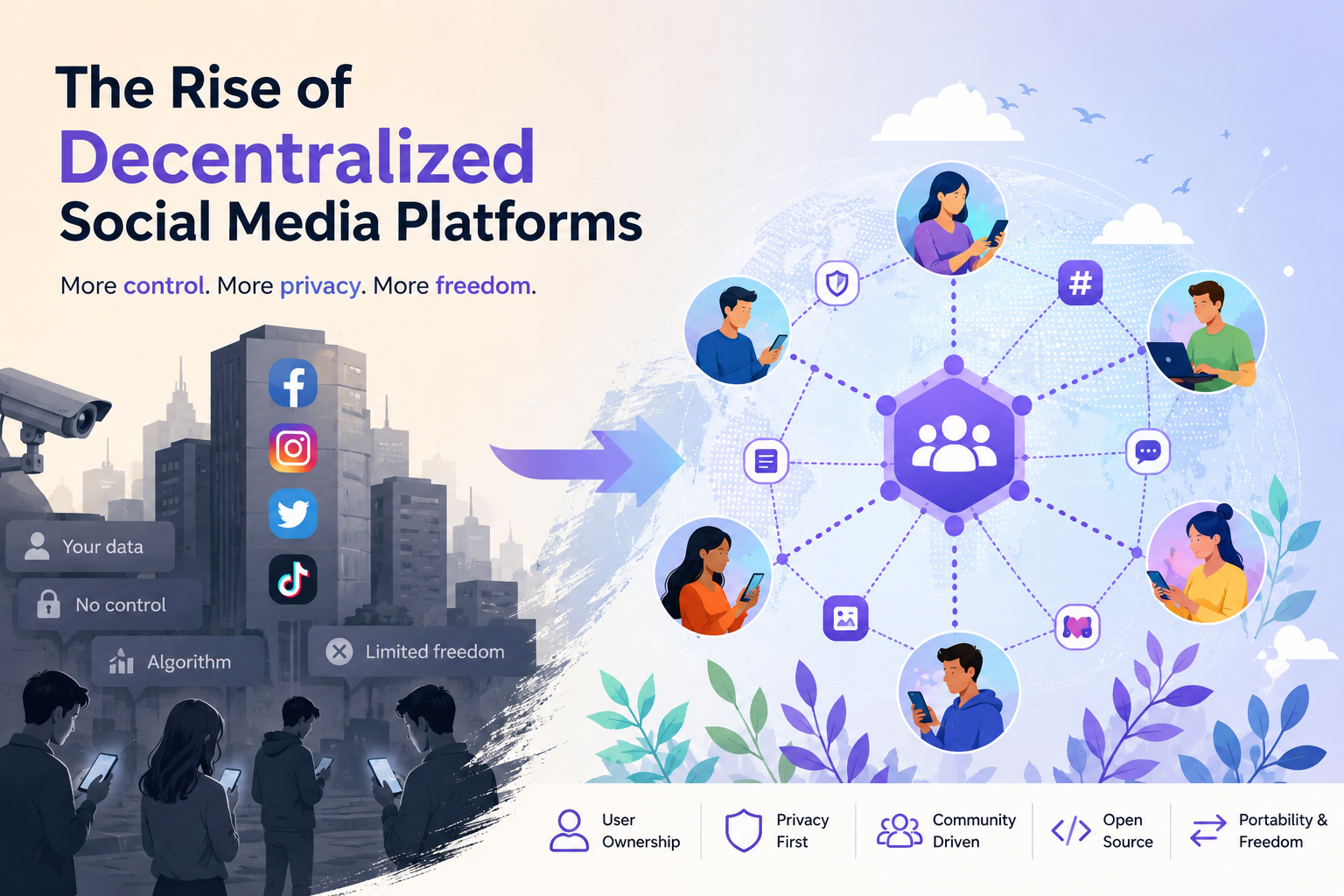
Decentralized social media is a new way of thinking about online communication. Decentralized platforms are made up of many independent servers, communities or networks, rather than one company that controls the entire platform. The basic idea is simple — users should have more control over their data, identity, content, and online experience.
Traditional social media platforms are centralized. And that means the platform is owned and controlled by a single company. The company sets the rules, controls the algorithm, owns the user data, controls the accounts and decides what gets pushed out and what gets taken down. For example, when someone uses a centralized platform, their profile, posts, followers, and messages are usually stored under that company’s system.
Decentralized social media works differently. A single authority does not control it. Instead, it may run through many connected servers or blockchain-based networks. Users can often choose where their data is stored, how they interact with others, and, in some cases, even transfer their identity from one platform or server to another.
The easiest way to think about this is to imagine that centralized social media is like one giant shopping mall owned by one company. Everyone inside must follow that company’s rules. Decentralized social media is more like many independent local markets connected by roads. Each market may have its own rules, but people can still communicate and move between them.
One major reason is privacy. On many traditional platforms, user data is collected and used for advertising, recommendations, and business decisions. Many people have become uncomfortable with how much personal information big companies can collect. Decentralized platforms are supposed to give users more control over their data.
Another reason is frustration with algorithms. Centralized platforms use algorithms to decide what you see. They tend to promote content that gets the most engagement, even if it is negative, misleading or addictive. Many users feel that they don’t control their own feeds anymore. Decentralized platforms also tend to provide more user choice in what they see and how content is organized.
Censorship and moderation are also important issues. Some users feel large platforms have too much power to remove content or ban accounts. Others believe that moderation is necessary but should be more transparent and community-based. Decentralized platforms try to solve this by allowing different communities to create their own moderation rules.
The rise of creator culture is another factor. Many creators depend on social media platforms for their audience and income. But if a centralized platform changes an algorithm, deletes an account or limits reach, a creator could lose years of work overnight. Decentralized platforms offer the possibility of stronger ownership, where creators can keep better control over their audience and content.
One of the most important features is user ownership. In decentralized systems, users may have more control over their profiles, posts, followers, and digital identity. This means their online presence is not entirely dependent on a single company.
Another feature is openness. Many decentralized platforms are open-source, meaning developers can inspect, improve, or build on the technology. This encourages innovation and transparency.
Community control is also a major feature. Instead of one company making all the decisions, communities can set their own rules. This can create more flexible and diverse online spaces.
Portability is another important idea. In the future, users may be able to move their accounts, content, or followers between different platforms more easily. This would reduce the risk of being locked into one social media company.
Several decentralized social media platforms have gained attention in recent years. Mastodon is one of the most well-known examples. It works through independent servers, often called instances, that can communicate with each other. Users can join a server that matches their interests or values.
Bluesky is another platform focused on a more open social networking system. It aims to give users more control over their online identity and content experience.
Farcaster is a decentralized social network that focuses on giving users ownership of their accounts and social connections. Lens Protocol is another example, designed especially for creators and Web3 communities.
These platforms are still smaller than major traditional social networks, but they show that the demand for alternatives is growing.
The biggest benefit is control. Users are not completely dependent on a single company. They may have more power over their identity, data, and content.
Another benefit is privacy. Since decentralization can reduce the control of large data-collecting companies, it may create a better environment for users who care about personal information.
Decentralized platforms can also reduce monopoly power. Today, a few major companies control much of online communication. Decentralized social media gives people and communities more choices.
Transparency is another benefit. Open systems allow users and developers to understand better how platforms work. It can help build trust.
Finally, decentralized social media can encourage healthier communities. Smaller, community-led spaces may feel more personal and less controlled by viral trends or engagement-focused algorithms.
Although decentralized social media has many advantages, it also faces challenges.
The first challenge is ease of use. Many decentralized platforms can feel confusing for beginners. Choosing a server, understanding protocols, or managing digital identity can be difficult for people who are used to simple sign-up processes.
Another challenge is moderation. While community-based moderation can be positive, it can also become complicated. Different communities may have different rules, and harmful content can be harder to control across a decentralized network.
A smaller user base is also a problem. People usually join social media platforms because their friends, family, favorite creators, and communities are already there. Decentralized platforms must attract enough users to become truly useful.
There are also technical and security risks. Some blockchain-based platforms may involve wallets, tokens, or digital assets, which can create confusion or risk for users who are not familiar with the technology.
The rise of decentralized social media matters because it represents a shift in digital power. For many years, the internet has become increasingly controlled by large platforms. These companies decide how people communicate, what content becomes visible, and how user data is used.
Decentralized social media challenges this model. It suggests that the future of online communication could be more open, user-owned, and community-driven. It gives people a chance to rethink what social media should be.
This does not mean that centralized platforms will disappear. They are still powerful, popular, and easy to use. But decentralized platforms offer an important alternative. They remind users that social media does not have to be controlled by only a few companies.
The future of decentralized social media will be whether these platforms can become easier to use, safer, and more attractive to everyday users. For decentralization to become mainstream, it must not only appeal to technology experts. It must also work for ordinary people who simply want to connect, share, and communicate.
If decentralized platforms can solve problems like usability, moderation, and growth, they may become a major part of the future internet. Even if they do not fully replace traditional platforms, they can still influence how social media evolves.
Big platforms may also adopt some decentralized features, such as greater data portability, more transparent algorithms, or improved user control. In this way, the rise of decentralized social media could push the entire industry toward a more user-friendly future.
The rise of decentralized social media platforms indicates that people are looking for a better online experience. They want more privacy, more control, more transparency and less dependence on the big tech companies. Decentralized platforms offer a new vision of social media where users and communities have more power.
Although these platforms still face many challenges, their growth is important. They represent a digital movement toward freedom, ownership, and fairness online. As the internet continues to evolve, decentralized social media may play a major role in shaping the future of communication.


