 Loading Please Wait...
Loading Please Wait...
Loading Please Wait...
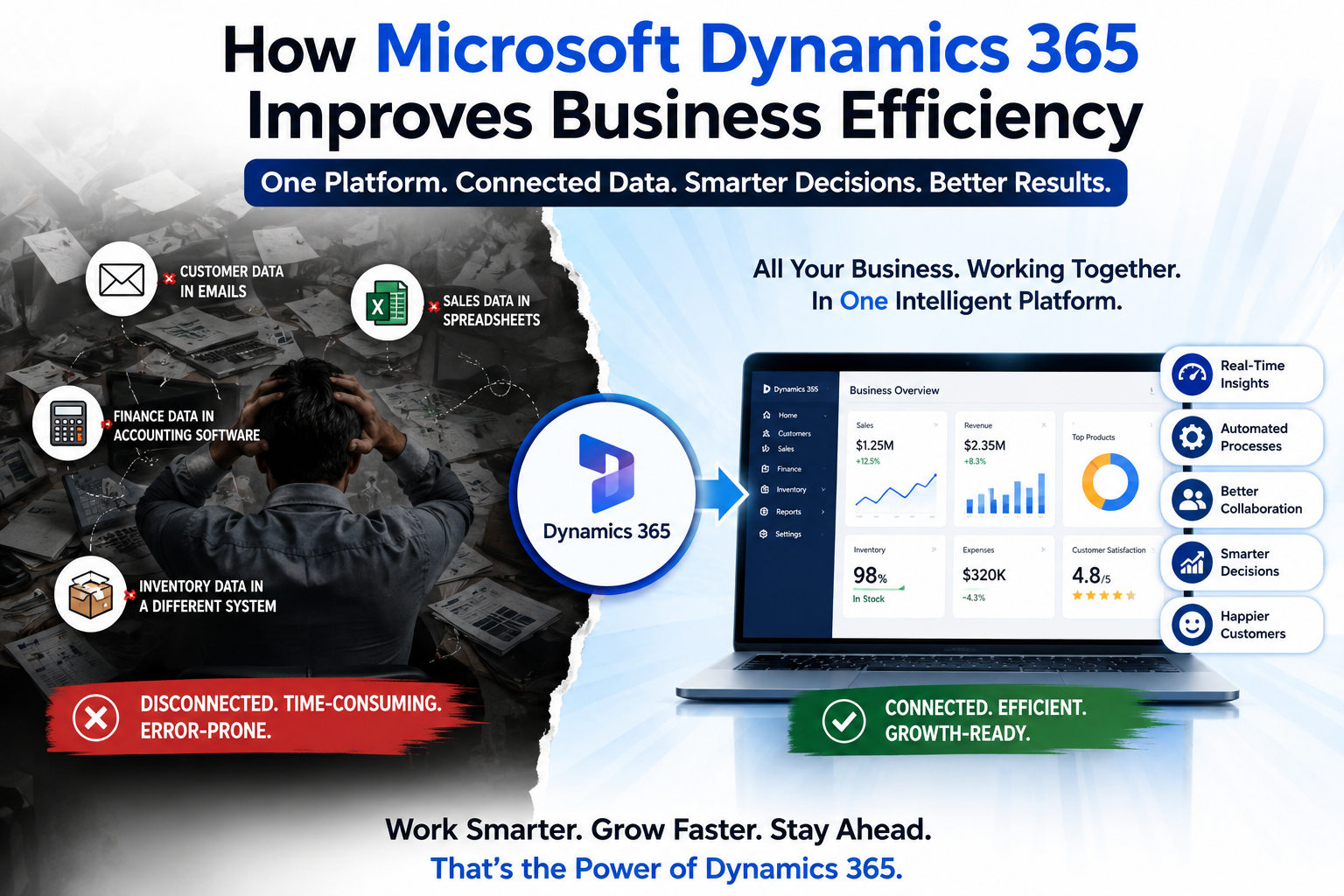
Many businesses work hard every day but struggle to expand because their systems are incompatible. Sales teams might use one tool, finance might use another, customer service might rely on spreadsheets, and warehouse teams might manually track inventory. When information is spread across multiple systems, employees waste time searching for data, correcting errors, and requesting updates from other departments.
For example, suppose a sales executive assures a customer that a product is available, but the inventory team later informs them that it is out of stock. Or the finance team creates a report using outdated data because the most recent sales figures have not been updated. These minor issues can cause delays, unhappy customers, and lost revenue.
In today's competitive market, operational efficiency is not an option. Businesses need to work faster, serve customers better, reduce errors, and make smart decisions quickly. This is where Microsoft Dynamics 365 proves useful.
Microsoft Dynamics 365 is a cloud-based business application platform that combines ERP and CRM capabilities. In simple words, it enables businesses to manage customers, sales, finance, supply chain, service, and operations from a single connected system. In this blog, you will learn how Microsoft Dynamics 365 improves business efficiency and why it is useful for modern organizations.
Microsoft Dynamics 365 is a collection of intelligent business applications designed to help businesses manage various aspects of their operations. Businesses can use Dynamics 365 to connect sales, accounts, customer support, and inventory, rather than using separate tools for each.
Dynamics 365 includes both ERP and CRM capabilities.
ERP stands for Enterprise Resource Planning. It helps manage internal business operations such as finance, accounting, supply chain, procurement, inventory, manufacturing, and project management.
CRM stands for Customer Relationship Management. It helps manage customer-related activities such as sales, marketing, customer service, leads, opportunities, and customer communication.
For example, ERP helps answer questions like, “How much stock do we have?” or “What are our monthly expenses?” CRM helps answer questions like, “Which customer is interested in our product?” or “Which support ticket needs urgent attention?”
Some key Microsoft Dynamics 365 modules include Dynamics 365 Sales, Customer Service, Field Service, Finance, Supply Chain Management, Business Central, Customer Insights, and Project Operations. Businesses can choose the modules they need and add more as they grow.
One of the most significant ways Microsoft Dynamics 365 improves business efficiency is by centralizing data. In many organizations, customer information, sales records, financial data, and inventory details are stored across different tools and platforms. This creates data silos.
A data silo means one department has information that others cannot easily access. When teams do not have the same information, mistakes happen. Employees may duplicate work, use outdated data, or make decisions without seeing the full picture.
Dynamics 365 solves this by creating a single source of truth. All important business data can be stored and accessed from one connected platform. Sales teams can see customer history, finance teams can view billing information, and service teams can understand previous complaints or requests.
For example, if a customer calls support about a delayed order, the support executive can quickly check order status, payment details, and delivery information. They do not need to call the warehouse, ask finance, or search through multiple files. This saves time and improves the customer experience.
Centralized data also improves collaboration. When everyone works from the same updated information, departments can coordinate better and complete work faster.
Manual tasks take up a lot of employee time. Activities like sending follow-up emails, creating invoices, updating records, assigning leads, tracking approvals, and preparing reports can become repetitive and boring. More importantly, manual work increases the chance of human error.
Microsoft Dynamics 365 helps automate these routine processes. Automation means the system can complete certain tasks based on predefined rules.
For example, when a new lead fills out a website form, Dynamics 365 can automatically create a lead record, assign it to the right salesperson, and send a follow-up reminder. In finance, the system can help automate invoice generation, payment tracking, and approval workflows. In customer service, it can route cases to the right support agent based on issue type or priority.
This improves efficiency because employees spend less time on repetitive admin work and more time on valuable tasks. Sales teams can focus on closing deals. Finance teams can focus on planning and analysis. Customer service teams can focus on solving customer problems.
Automation also brings consistency. Every process follows the same steps, so there is less confusion and fewer missed tasks.
Good decisions need good data. If business leaders depend on outdated reports, they may react too late. In fast-moving markets, delayed decisions can cost money.
Microsoft Dynamics 365 provides real-time insights through dashboards, reports, and analytics. Managers can view sales performance, cash flow, inventory levels, customer service trends, and operational performance in one place.
For example, a sales manager can quickly see which products are selling well, which sales representatives are performing best, and which deals are likely to close. A finance manager can monitor expenses and revenue without waiting for end-of-month reports. A warehouse manager can identify low-stock items before they become a problem.
These real-time insights help businesses act faster. Instead of guessing, teams can make decisions based on accurate data.
For example, if the dashboard shows that customer complaints are increasing for a particular product, the company can investigate the issue quickly. If inventory data shows high demand for a product, the business can reorder before stock runs out. This kind of quick action improves efficiency and customer satisfaction.
Financial management is one of the most important parts of any business. If finance processes are slow or inaccurate, the entire business can suffer. Manual accounting, delayed invoicing, poor budget tracking, and disconnected financial reports can create serious problems.
Microsoft Dynamics 365 helps streamline financial management by connecting finance with other business operations. It can help businesses manage accounts, invoices, budgets, expenses, cash flow, tax-related data, and financial reporting more efficiently.
For example, when a sales order is completed, the finance team can access the related billing information without asking the sales team for details. This reduces delays in invoicing. If a customer payment is pending, the system can help track it and alert the team.
Dynamics 365 also helps leaders understand financial performance more clearly. They can compare budgets with actual spending, monitor profitability, and forecast future financial needs.
For growing businesses, this is especially useful. Instead of relying only on spreadsheets, they can use a structured system that reduces manual work and improves accuracy.
Supply chain and inventory problems can directly affect customer satisfaction. If a company has too much stock, money gets blocked. If it has too little stock, orders get delayed. If suppliers are not managed properly, production or delivery can suffer.
Microsoft Dynamics 365 helps businesses manage supply chain and inventory more efficiently. It provides better visibility into stock levels, purchasing, warehouse activities, demand planning, and supplier performance.
For example, a retail business can use Dynamics 365 to see which products are selling quickly and which products are not moving. Based on this data, the business can reorder popular products and avoid overstocking slow-moving items.
A manufacturing company can use it to track raw materials, production schedules, and supplier deliveries. If there is a delay from one supplier, the team can take action earlier instead of discovering the issue at the last moment.
This improves efficiency because businesses can plan better, reduce waste, avoid stockouts, and deliver products on time.
Another major reason Microsoft Dynamics 365 improves business efficiency is its use of AI and automation. AI helps employees work smarter by giving suggestions, summarizing information, identifying patterns, and supporting faster decisions.
For example, a salesperson can use AI-supported insights to understand which leads are more likely to convert. Customer service agents can get suggested responses or case summaries, helping them solve issues faster. Finance teams can use AI-driven insights to identify trends, risks, or unusual spending patterns.
AI is useful because it reduces the time employees spend searching, reading, and analyzing large amounts of information. It helps them focus on action.
For example, instead of reading a long customer history manually, a service agent can quickly view a summary and understand the problem. Instead of checking every sales opportunity one by one, a sales manager can see which deals need attention.
When AI, automation, and connected data work together, productivity improves across the whole organization.
Microsoft Dynamics 365 improves business efficiency by helping companies connect their people, processes, and data. It removes data silos, automates repetitive tasks, provides real-time insights, improves financial management, and optimizes supply chain operations.
The main benefit is simple: businesses can work faster with fewer errors. Employees do not have to waste time searching for information or repeating manual tasks. Managers can make better decisions using real-time data. Customers receive faster and more reliable service.
Whether a company wants to improve sales, manage finances, support customers, or control inventory, Dynamics 365 provides tools to make daily operations smoother and smarter.
In a competitive market, efficiency can be the difference between growth and struggle. Microsoft Dynamics 365 helps businesses become more organized, productive, and ready for the future.


